
• Skip to primary navigation
  • Skip to main content
  • Skip to primary sidebar

Cultivage

Cultivating talent and creating opportunities

  • Home
  • About
  • Professional Development
  • Coaching Services
  • Speaking Services
  • Ideas that Matter
  • Contact
  • Show Search
Hide Search

Ideas that Matter

Balancing Instincts and Stakeholder Input in Decision-Making

Maureen Breeze · Dec 1, 2025 ·

I recently coached a leader who received feedback that she needed to make more confident, decisive choices. As we began our work together, I asked her to describe how she approached complex business decisions.

She outlined a thoughtful process: identify the root cause of the problem, gather input from others, consider the impact on stakeholders, weigh the pros and cons, and then decide. With a laugh, she admitted, “It’s not this streamlined though. I tend to get weighed down by the options. I know I’m slow to pull the trigger.”

Curious, I asked about her instincts. When do you pause to listen to yourself?
She replied, “Hmm…I guess I don’t typically do this. I think my instincts surface as I move through the data I’m collecting.”

I invited her to experiment: what if she began by reflecting privately to listen to her instincts and review critical data points before gathering external perspectives? She agreed to try.

Ahead of her annual budget recommendations, she drafted a version of the department budget for her eyes only. Then she followed her usual process of gathering input and considering stakeholder impact. Finally, she returned to her draft, integrating her initial insights with what she had learned from her team.

The result? She felt more grounded and confident in her budget decisions. By starting with her own perspective, she avoided over-indexing on external voices that lacked the full picture. She could compare her instincts with others, identify blind spots, and make adjustments. This balance gave her clarity and alignment with her internal compass while honoring stakeholder input. And while the process took time, she didn’t feel ‘stuck’ in her decision-making process like she often did.

The Broader Lesson

In my years of coaching leaders, I’ve noticed a common tension: many lean too heavily on one end of the spectrum—either their own instincts or external perspectives.

By “instincts,” I don’t mean impulsive reactions, but a reflective, deliberate process of internal sense-making. Nobel Prize–winning economist Daniel Kahneman distinguished between fast, automatic thinking (often prone to bias) and slow, deliberate reflection, which supports better decisions in complex problem-solving.

Leaders who depend only on their internal ‘sense-making’ risk missing critical factors and alienating their teams. In these instances, I see teams struggle to buy-in to a leader’s decisions if their perspectives are never considered.

Conversely, leaders who are heavily invested in collaboration and rely primarily on others’ perspectives may risk overlooking the unique industry, institutional, or relational knowledge that earned them their role. In these situations, I often hear team members express a desire for their leaders to make decisions so that the team can more efficiently move forward.

It’s a fine line that requires nuance. Knowing when to collaborate and share the decision-making process, and when to step in, make the call, and determine the direction for the team, is a hallmark trait of great leadership. Learning the skills to manage decision-making can feel like a process of trial-and-error. It can help to ask yourself a few questions before you begin and as you move through the decision-making process.

  • What are my initial thoughts or instincts about this decision?
  • What process will I move through to find clarity?
  • Who will be impacted by this decision and what input do they need to have in making the decision? (Consider stakeholders, employees, other leaders, etc.)
  • How will I balance my instincts with feedback from others?

By intentionally balancing reflective insights with stakeholder perspectives and adapting their approach to the context, leaders can cultivate the agility that brings clarity, confidence, and alignment to even the most complex decisions.

Understanding Your Impact as a Leader

Maureen Breeze · Jun 16, 2025 ·

Leo Tolstoy once said, “Everyone thinks of changing the world, but no one thinks of changing oneself.”

Leaders tasked with running organizations and driving initiatives are expected to deliver results. To succeed, they often focus on external variables—team performance, operational efficiencies, or budget management—without considering how they might need to evolve personally.

If leadership is about achieving results through effective relationships, a leader’s impact becomes crucial. Understanding what to change in oneself to strengthen relationships and enhance outcomes can provide a powerful competitive advantage. That’s why I often encourage leaders to reflect on this pivotal question: What impact do I have on others?

Self-Awareness: A Leadership Superpower

For leaders to truly understand their impact, they must cultivate a high level of self-awareness. Yet research reveals a striking disconnect: while 95% of people believe they are highly self-aware, only 10-15% actually are.

Taking inventory of one’s strengths, gathering feedback, and assessing how leadership influences the team can set the foundation for long-term success. Let’s explore three key areas where leadership has a direct effect: emotional experience, working process, and decision-making abilities.

  1. Emotional Experience

In The Heart of Business, Hubert Joly recounts his journey leading Best Buy through a major turnaround. On the eve of Black Friday, a critical sales day, the company’s online purchasing system crashed. Walking into the crisis meeting, Joly paused to remind himself that, as the leader, he was responsible for setting the emotional temperature.

Managing his own frustration and anxiety was essential. If he entered the room too hot or too cold, it would hinder his team’s ability to stay resourceful and persistent as they worked toward a solution. With a calm, cool, and collected presence, Joly was able to lead the team through the crisis.

Leaders, like thermostats, regulate the emotional temperature of their teams. As Daniel Goleman, renowned for his research on emotional intelligence, writes in Primal Leadership,
“The leader’s mood is quite literally contagious, spreading quickly and inexorably throughout the business.”

What emotional temperature are you setting for your team?

  1. Working Process

A simple yet powerful exercise for leaders to better understand their impact involves asking their teams two questions:

  • What do I do that helps you do your work?
  • What do I do that interferes with your ability to work effectively?

A senior executive at a manufacturing company used this approach and uncovered an unexpected insight. Her penchant for idea generation, which she saw as her strength, was overwhelming her team.

She frequently tossed out ideas in meetings, but her team interpreted them as mandates, pulling them in conflicting directions and causing constant fire drills. After receiving feedback, she began framing her thoughts explicitly as either “ideas” or “requests.” She also committed to clarifying priorities at the end of each meeting to help her team stay aligned.

While she understood that idea generation was her superpower, she hadn’t realized its unintended effects.

What might you learn by asking your employees what you do that helps or hinders their work?

  1. Decision-Making Abilities

Leaders can unintentionally create hesitation and fear in their teams by failing to communicate a clear vision or criteria, which can disrupt the team’s ability to make effective decisions.

Consider a Senior VP of Production at a media company who frequently vacillated between strategies and failed to commit to a direction. As deadlines approached, her two directors made financial decisions to hire contractors and allocate resources based on one strategy. But when the Senior VP suddenly shifted course without sufficient warning, those directors found themselves locked in commitments that led to missed deadlines and budget overruns.

When leaders fail to provide timely and clear guidance, employees may take suboptimal action, or worse, hesitate to make critical decisions altogether.

How does your leadership impact your employees’ ability to make decisions?

Leadership Starts with You

Developing deep awareness of your impact can empower you to strengthen relationships and drive meaningful results. Returning to Tolstoy’s wisdom – that changing ourselves can enhance our influence, which in turn improves outcomes – I invite you to consider the following:

What’s one step you can take today to increase awareness of your impact by 5%?

Managing Performance: Accountability, Feedback, and Coaching

Maureen Breeze · Mar 6, 2025 ·

The challenge of addressing employee underperformance requires a clear, targeted approach, one that many executives and mid-level managers aspire to master. However, they can easily miss the mark by neglecting to delineate specific actions within the process. This requires a thorough examination of three pivotal facets of performance improvement discussions, specifically accountability, feedback, and coaching.
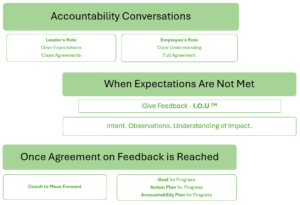


To start, front-end accountability conversations are crucial for establishing a foundation of mutual understanding. Here, clarity is paramount; leaders must articulate their vision and set clear goal posts for success. In addition, agreements need to be made regarding who will be doing what by when, and how the process will be communicated along the way. In balance, employees must fully grasp these expectations, seeking clarification where necessary. While mastering successful front end accountability conversations sets the stage for a collaborative effort to achieve desired outcomes, they aren’t always an easy feat. In fact, when done poorly, they can contribute to poor employee performance. I’ll write more on this topic later.

However, successfully setting expectations is merely the beginning. The real challenge lies in bridging the performance gap when expectations aren’t met. This is when back-end accountability conversations must happen to address the gap between expectations and reality.

Here is where the art of feedback comes into play. Effective feedback is not merely about holding individuals accountable but also about evaluating how well the initial agreements were adhered to.

I encourage leaders to use Cultivage’s I.O.U.™ approach:

  • share your Intent for the feedback
  • offer Observations of the situation/data rather than an interpretation of the events
  • explain your Understanding of the impact. Utilizing this Intent, Observation and Understanding method, leaders can provide feedback that is anchored in data and facts, thus fostering a constructive dialogue about performance gaps and their impact.

Once the performance gap is acknowledged, the conversation can transition to coaching. Here, the leader’s role is to ask probing questions, listen attentively, and challenge the employee’s thought process. The aim is to co-create a plan for improvement, one that the employee feels invested in. This collaborative approach not only enhances commitment to the plan but also empowers the employee to take ownership of their performance.

In essence, when performance falls short, breaking down the conversation into these three components—accountability, feedback, and coaching—can lead to more effective performance improvement and a stronger leader-employee partnership.


Leadership & Listening: Creating Understanding and Cultivating Connection

Maureen Breeze · Oct 1, 2024 ·

Last month I facilitated a team offsite for global leaders. Employee engagement on the team had plummeted. The chief complaint was the leadership’s listening. Team members insisted that leadership wasn’t hearing them, while the leaders felt they’d made significant efforts to listen by collecting feedback in meetings, on calls, and through surveys.

There was a significant disconnect.

These highly successful global leaders have impressive records for turning business units around and achieving challenging KPIs. At the time of our meeting, they were outperforming all expectations for a large-scale global transformation. However, they were struggling to bring the team along in the process.

They are not alone. This is a situation I witness regularly in leadership development.

High performing leaders are often known for their vision and problem-solving abilities. To support these abilities, they usually listen with the intent to gather information and make tough decisions. Yet they often miss opportunities that come from listening with the intent to build rapport. As a result, team members may be listened to but not understood.

For leaders who thrive and succeed by moving fast, slowing down to build connection feels inefficient. And leaning into empathy feels soft. Yet embracing the value of strategic empathy can help leaders listen openly and find common ground, which accelerates growth and transformation. It requires listening for fact and details, as well as for impact.

If you receive feedback that your listening needs improving, I suggest the following:

Before Conversations         

Take time to consider where people are coming from and the conditions that may inform their points of view:

  • What might they be thinking?
  • What might they know or not know?
  • What might they believe?
  • How might they feel?

During Conversations

Commit to curiosity. Resist the instinct to offer a quick solution. Instead, try the following:

  • Ask for more information. When people talk, remain open. Invite them to tell you more. Adopt a ‘perspective getting’ approach to better understand concerns and circumstances that contribute to their points of view.
  • Share what you heard. Check your understanding. Ensure you are truly hearing what they are saying and check this information against assumptions about what you believed they thought, understood, believed, and felt.
  • Acknowledge their experience. Acknowledgements show that you see someone’s experience. Comments such as “It sounds like this is frustrating,” or “I’m seeing how this can feel confusing,” help people to feel seen. An acknowledgement doesn’t necessarily mean that you agree with their point of view, but that you see the impact the situation is having on them.
  • Thank them for offering their thoughts. While you may not agree with everything that is said, an authentic ‘thank you’ demonstrates your ability to offer dignity in a potentially difficult situation.

After Conversations

  • Work from common ground. By following these steps, you may discover common ground and identify creative ways to address some of the concerns expressed. You can then act on these items and build trust by following through on your commitments as a leader.
  • Share your reasoning. When you must take a hard line and make an unpopular decision, you’ll be better positioned to share your reasoning in ways that team members understand and accept, because they’ve been actively listened to along the way.

The global leaders I mentioned earlier took a courageous step to address their employees’ discontent by participating in a two-day listening tour with their team. During this exercise, they paused to listen deeply with the intent to understand, they resisted being defensive and instead remained curious and asked questions. They also built rapport by acknowledging their direct reports’ experience.

Much work remains to be done by these leaders. Guiding a team through difficult transformation is a long game. However, the time they invested in listening built the requisite connection to move forward as an organization.

Flexing Your Strategic Communication Muscle: Speaking to the Point

Maureen Breeze · Jul 8, 2024 ·

Clients often tell me that they want to be more strategic with their communication. They share that they find themselves saying more than they’d like and taking too long to get to their point.

It is common to think out loud and share our thoughts as we work our way to meaning. Doing so can help us develop our point of view. But when the stakes are high and a concise and clear message is needed, meandering costs us.

When coaching a client on this skill, I share the IPD framework – Intent, Punchline, & Details.

To apply IPD to your situation, begin by asking “What do I want my audience to know and be able to do?” Keep it simple. Do you want them to understand the context surrounding a problem or make a decision based on key data?  Perhaps you want them to pause and reflect on contrarian points of view. Knowing your overarching intent helps you shape your punchline.

The next step is to distill your thoughts into a one sentence punchline. How much more powerful is “It’s in the company’s best interest to explore alternatives for this contract,” than “I’m feeling a little uncomfortable with the quotes we’re received and worry that the vendor doesn’t really understand our objectives. And, I mean, if we have more options to choose from, you never know, we might be surprised. Last year, it felt like we might have moved too fast. And there might be other options that we haven’t considered that could be beneficial…”?

It’s critical to find your punchline and land it.

Next, decide how much supporting detail to include. You want to make your case, but you don’t want to lose focus. Typically, one or two data points or details will successfully frame your point of view and launch a conversation without losing your audience.

This process sounds like a lot to implement in the moment. However, it gets easier the more you practice.

I recommend thinking ahead about situations where you’ll need to offer your perspective. Write out your responses to the following:

  • What does my audience need to know or be able to do?
  • What is my punchline?
  • What are the critical details to share up front?

Then rehearse your response several times. I encourage you to experiment with this process before 1:1s, interviews, client meetings, and board sessions – wherever you need to be strategic and to the point.

As you think about your communication in this way & practice creating powerful punchlines, you will find that it not only becomes easier to avoid speaking in circles, but it frees up your energy so that you can deliver your message with greater conviction.


  • Go to page 1
  • Go to page 2
  • Go to page 3
  • Interim pages omitted …
  • Go to page 6
  • Go to Next Page »

Primary Sidebar

Ideas That Matter – The Cultivage Blog

From neuroscience to behavior economics, read musings on the latest research and trends that impact and reflect how we work and live.

Contact Us

Contact us for more information  Email Us Today!


Copyright © 2025 | Cultivage | (303) 912-0271 | email

  • Home
  • About
  • Professional Development
  • Coaching Services
  • Speaking Services
  • Ideas that Matter
  • Contact